LifeLinks
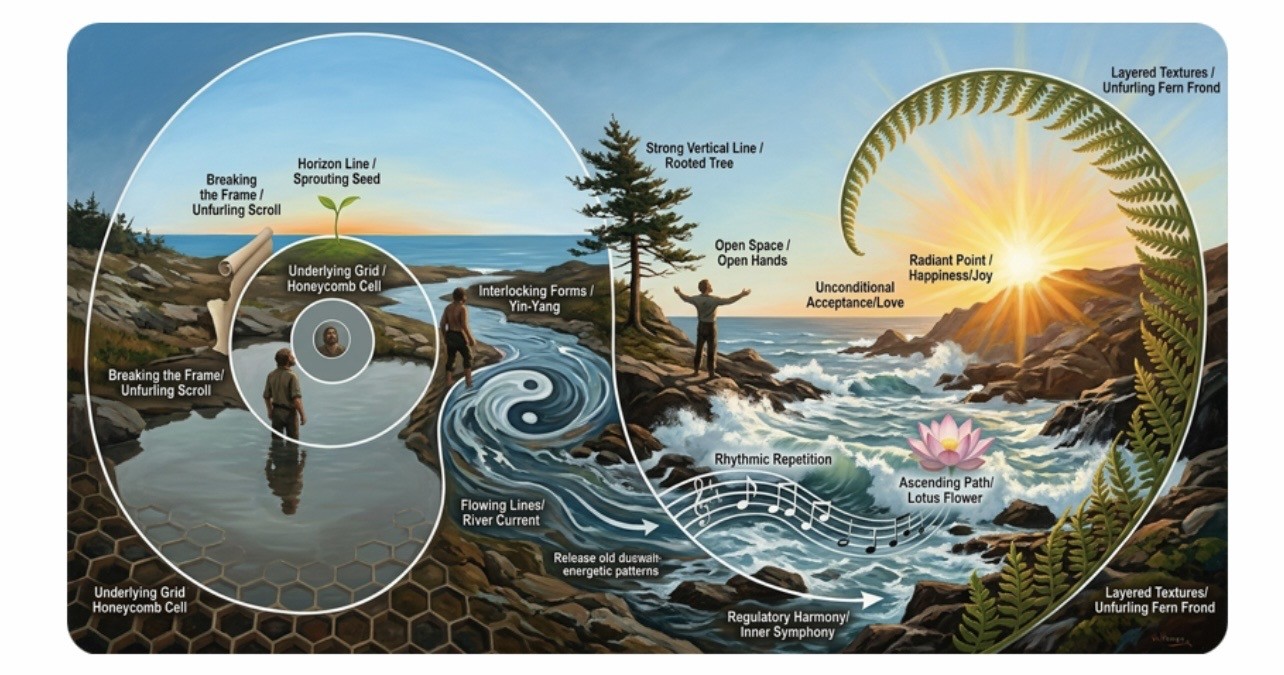
Initial Guide
The Vision Behind LifeLinks
Our reality is holographic. Every fragment contains the whole. A single cell carries the complete blueprint of the body. The iris maps the entire organism. A fingerprint, a grain of sand, any lived event — each is a complete hologram of the larger field and of our exact position within it. Coincidences are not accidents; they are the natural language of a holographic universe revealing itself.
The earlier Core system already worked with this principle. It used a random-number "hologram generator" to surface statistical correlations between apparently unrelated data. The results were often powerful, yet frequently difficult to relate cleanly to one another or to the living person. Human interpretation always carried bias. The multidimensional web of connections simply exceeded what a biological brain can hold in clear view at once.
A large language model changes the scale of what is possible. It is currently the most faithful working representation we have of the holographic structure of the universe itself. The same underlying model that generates coherent text can, with only small variations, compose music, generate images, or produce video. The basis is identical: dense, high-dimensional connectivity across tokens, across past and future context, across every perspective we choose to open. Where the human mind is forced to collapse complexity into linear narrative, the model can hold the full web and let us examine it from any angle we select.
LifeLinks is the practical expression of this shift. Instead of a random generator, we now use the face — the most personal and continuously available hologram a human being carries. The face is no longer treated as a static photograph. It becomes a living, daily mathematical interface between the individual and the larger field.

The Daily Face Hologram
Once a day you take two selfies:
- The neutral face — the expression you wear while standing at a bus stop, without any conscious attention directed at your appearance.
- The desired face — the subtle, intentional expression you would prefer to carry through life.
These two images are compared. The difference between them is treated as a precise holographic signature of your current individuality. From this signature the system reinterprets any existing report — Core results, medical evaluations, complementary assessments, or any other structured data — from the vantage point of your unique holographic position rather than from a generic statistical average.
This is only the visible surface. Much of what has already been built remains behind the interface for now: full simulation of the older Core system, deeper multi-agent architectures, and extensive internal tooling. What you see today is the first working layer — reinterpretation made practical, personal, and immediately usable.
Working with Reports
Every meaningful session begins with creating a base review. Once the creation activator has been run, adding activators becomes possible. Creation activators are organized in perspective groups (currently, Health and Spiritual with more to follow). For each type you select dynamic variables:
- From which religious or spiritual tradition the report should be read.
- From which medical, complementary, or integrative health system the same data should be examined.
The result is not a single fixed interpretation but a living reading that can be rotated through multiple coherent lenses. The same underlying information reveals different coherent patterns depending on the chosen perspective.
- First you need to create your INITIAL REVIEW
- Select one or several aims you have or leave it empty
- Specify the language in which the Review shall be presented
- Use any medical report; if PDF is not available use text format
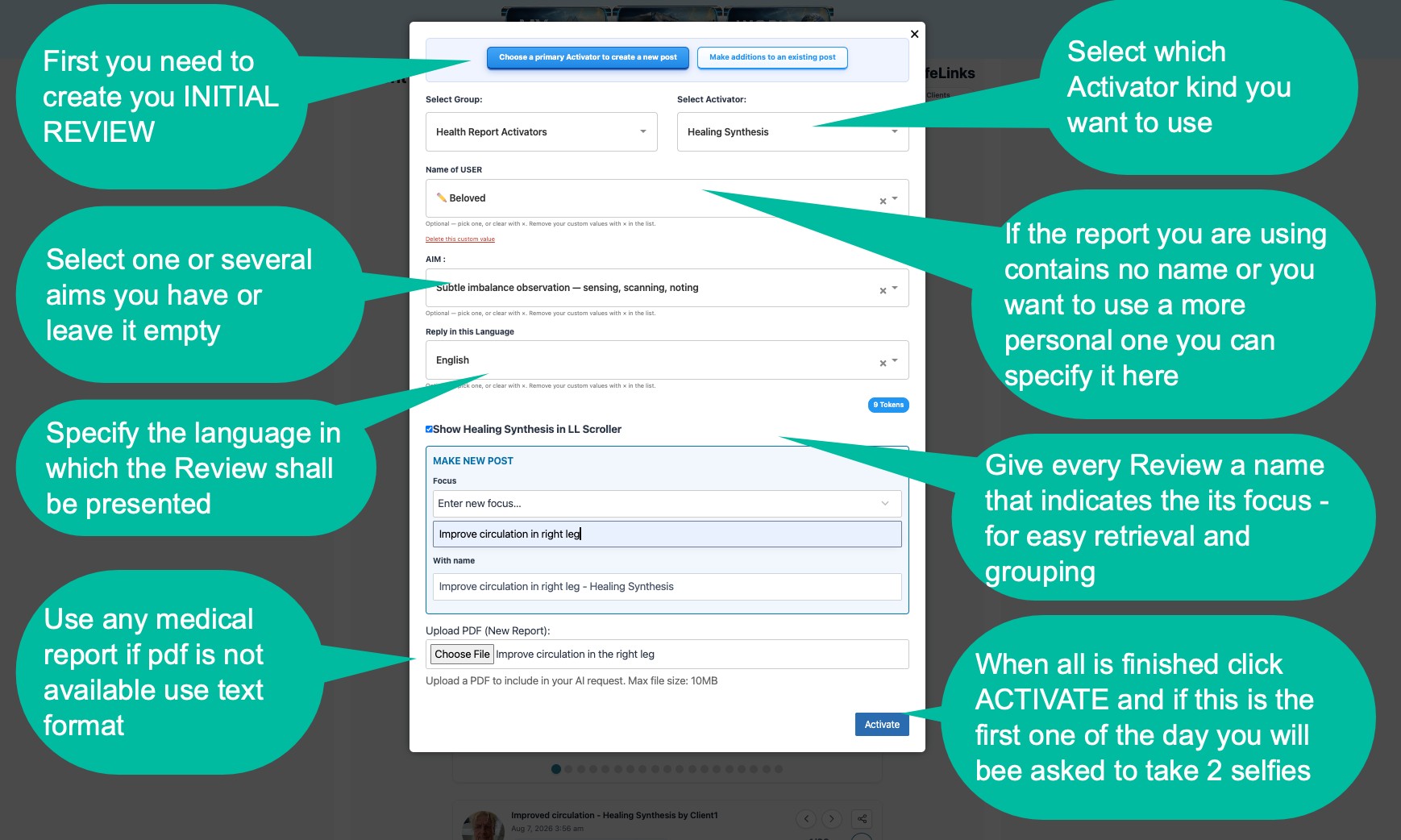
- Select which Activator kind you want to use
- If the report you are using contains no name, or you want a more personal one, you can specify it here
- Give every Review a name that indicates its focus — for easy retrieval and grouping
- When all is finished click ACTIVATE; if this is the first one of the day you will be asked to take 2 selfies
The Activator
After a re-evaluation is generated, you can add Addition Activators which allow to enrich it. Press "Add features" and you may attach:
- Music that condenses the essential themes of the report into an auditory form the subconscious can absorb through repetition.
- Graphs and metric charts.
- Images.
- Any combination of the above.
Each addition shows its token cost at the bottom of the interface. You may add as many layers as you wish. Every element (musical style, visual treatment, chart type, language) is controlled by individual dynamic variables inside the Activator dropdown. The person's name can be woven into the re-evaluation so the output becomes unmistakably personal.
- You can select specific features in these dropdown boxes or define your own
- Make sure you selected the correct post to attach it to
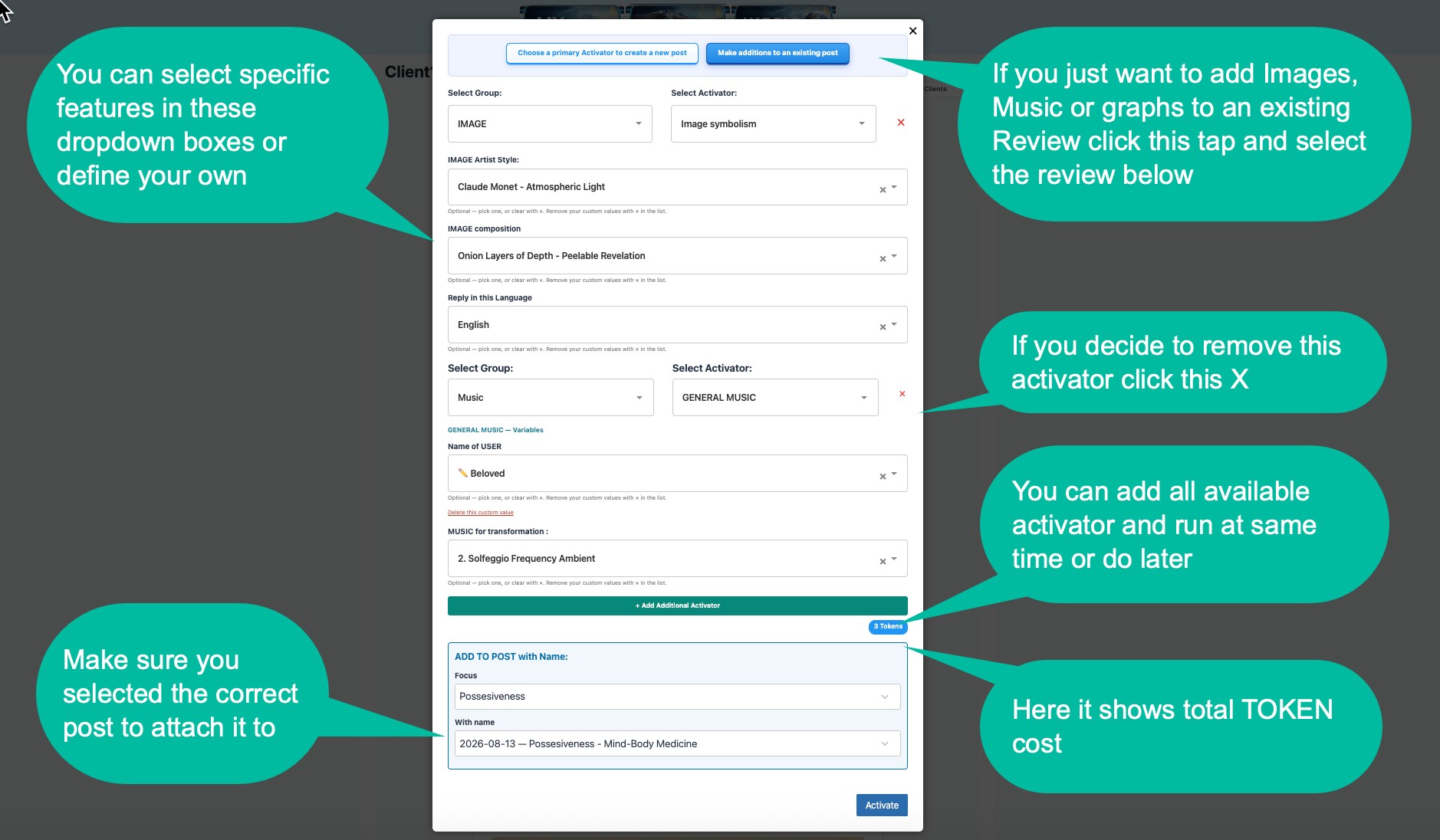
- If you just want to add Images, Music or graphs to an existing Review, click this tab and select the review below
- If you decide to remove this activator click this X
- You can add all available activators and run at the same time or do later
- Here it shows total TOKEN cost
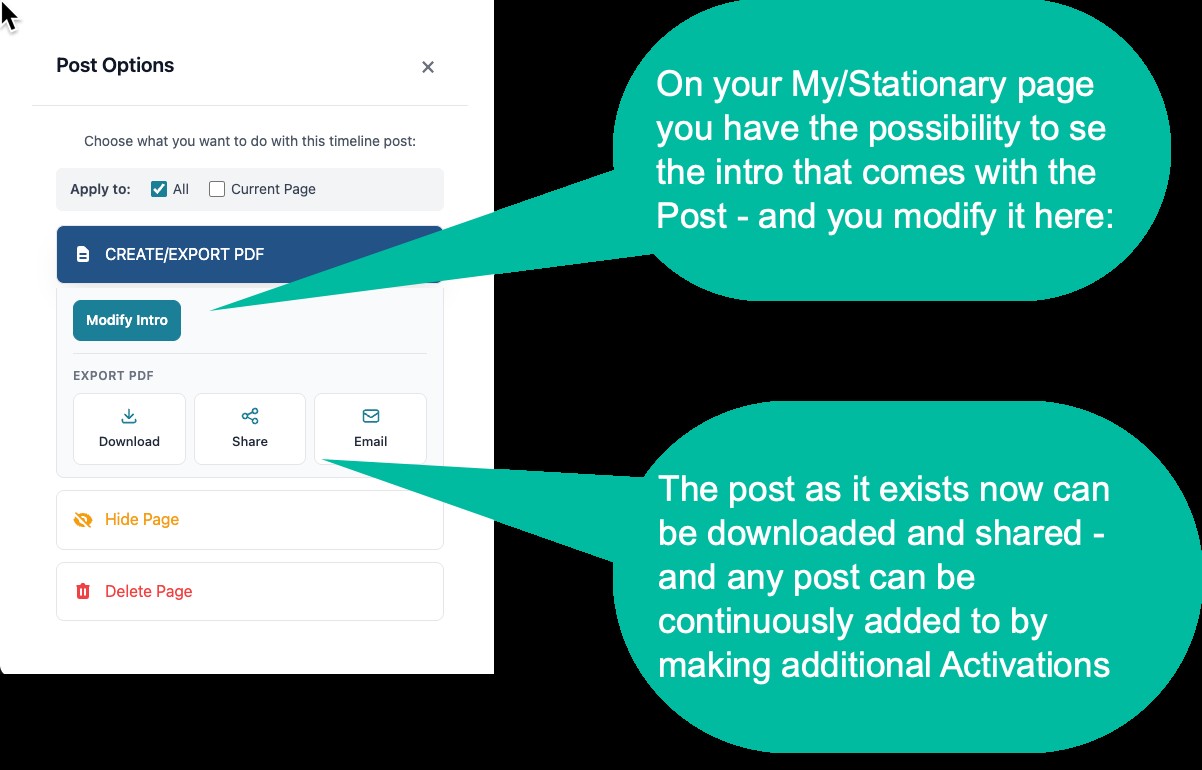
The finished report can be downloaded, emailed, posted to Facebook or X, or placed into your personal stationery. Stationery is created and customized under My Menu; once set, every report you generate can carry your visual identity.
- On your My/Stationary page you have the possibility to see the intro that comes with the Post — and you modify it here
- The post as it exists now can be downloaded and shared — and any post can be continuously added to by making additional Activations
- Here you can view and invite Friends, Guides, Clients
- Here you set whose posts you like on your timeline
- When you select ALL, also all the posts from other users that they have tagged as PUBLIC you will be able to view
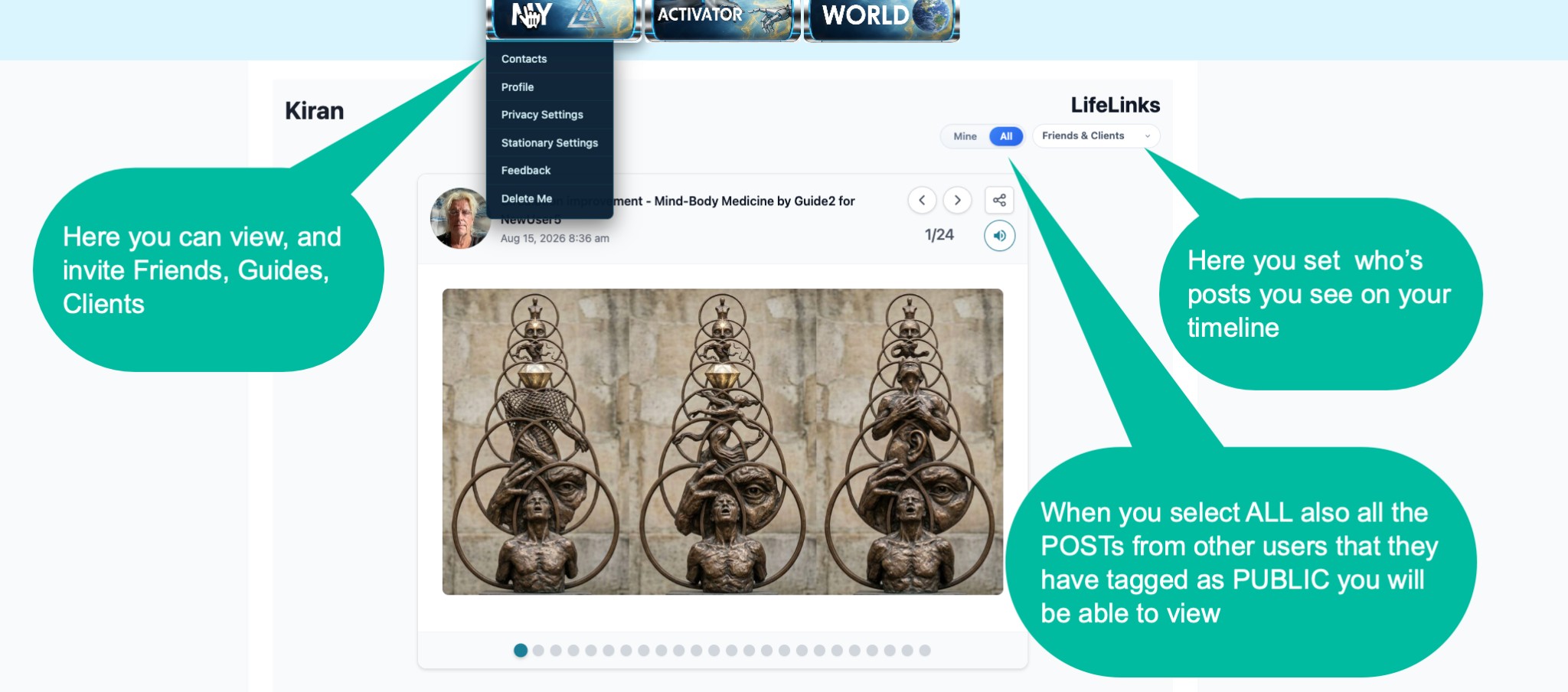
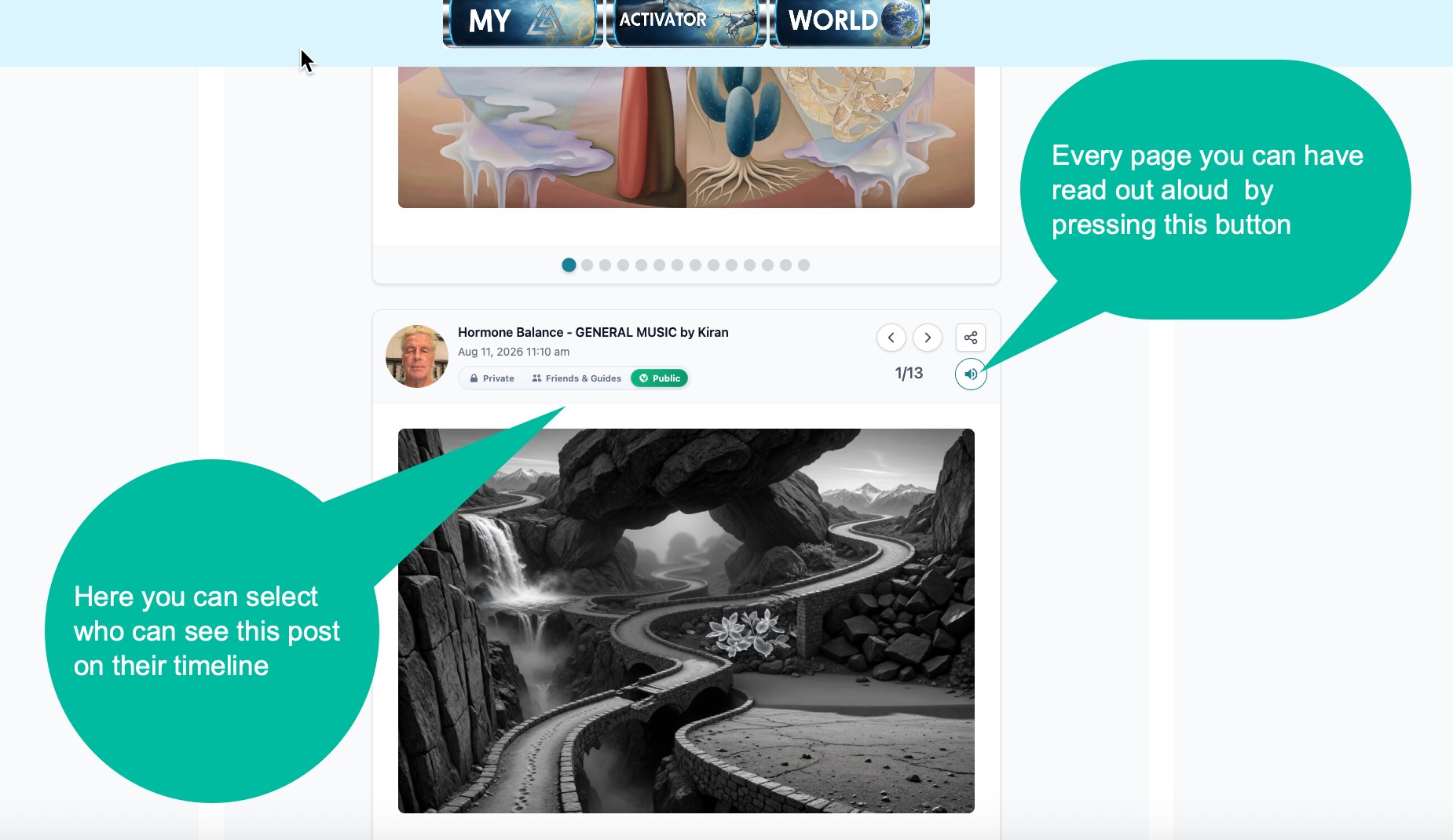
- Here you can select who can see this post on their timeline
- Every page you can have read out aloud by pressing this button
Relationships on the Platform
LifeLinks is designed for both individual use and guided collaboration.
- Friends can be invited with the option to become mutual co-creators. When this status is active, each person can run activations on behalf of the other.
- Clients establish a guide relationship. Once accepted, you can generate evaluations and re-evaluations for them, adding your own insight. These relationships are managed under My Contacts.
- Referrals allow you to invite new people. You receive 20% of their subsequent activation and purchase activity, tracked automatically. The same automatic percentage applies to activity generated by your clients.
Why the Name "LifeLinks"
Every health issue, every financial pattern, every question of happiness is downstream of the links we maintain to life itself. Too few links starve us. Wrong links distort us. Links that interfere with one another create friction across the whole field. LifeLinks exists to make those connections visible, measurable, and revisable — to strengthen the ones that nourish and to allow the ones that no longer serve to dissolve.
The name also carries a quiet nod to the work of Elon Musk. Neuralink and Starlink are literal expressions of the same intuition: that the quality of our links — neural, orbital, informational — determines the range of what becomes possible. We use Grok exclusively because, among current models, it consistently produces results that feel unusually aligned with the holographic and multi-perspective approach at the heart of this system. There is a shared temperament here — a refusal to accept that certain problems are permanently intractable, and a willingness to treat the universe as something that can be understood more deeply than yesterday's tools allowed. That orientation is not abstract for us; it is the practical reason Grok is the only model running inside LifeLinks.
A Note on What Is Still Coming
Everything described above is the first accessible layer. The larger architecture already contains far more: deeper simulation capabilities, expanded perspective libraries, richer multi-modal generation, and tools that will eventually let the system itself evolve its own internal models of each user. What you hold in your hands now is simply the working entrance.